 Parental Guidance · Activities · Development
Parental Guidance · Activities · Development
Fine motor activities for toddlers — simple things that build big skills
Why the mess is worth it, and eight activities that work with what you already have at home
March 15, 2026 · 8 min read
Fine motor skills are the small, precise movements that hands and fingers make — the ones that will eventually allow your child to hold a pencil, do up a button, use scissors, and feed themselves without turning the entire kitchen into a crime scene. They develop gradually through early childhood, and the best way to build them is not through worksheets or formal practice. It is through play. Specifically, the kind of play that involves hands, objects, and a reasonable tolerance for mess.
The activities below are not Pinterest projects. They do not require special equipment, an arts and crafts budget, or an afternoon free of interruption. They are things you can do on a Tuesday when you have twenty minutes and a toddler who needs occupying. Most of them will end in some form of chaos. All of them are doing developmental work you cannot see.
The activities
Playdough — the original fine motor tool
Age 18m+ · 10–30 mins · Low mess
If you only do one thing on this list, make it playdough. Squeezing, rolling, pinching, pressing, and pulling all work the small muscles of the hand in ways that directly build the strength needed for later pencil grip. You do not need to buy it — a simple salt dough made from flour, salt, and water works perfectly well and keeps for weeks in a sealed container.
Add loose parts — small stones, pasta, toothpicks, lolly sticks — and the activity extends significantly while also building pincer grip, which is the precise finger-thumb movement that underpins writing. Let your child lead. The snake they make six hundred times in a row is serving a purpose.
Transferring with tongs or spoons
Age 2+ · 10–20 mins · Low mess
Two bowls, a set of tongs or a large spoon, and something to transfer — pompoms, dried pasta, small balls, cubes of sponge. The task is simply to move the objects from one bowl to the other. It sounds almost insultingly simple. It is, developmentally, a great deal of work: hand-eye coordination, bilateral hand use, grip strength, and concentration are all required simultaneously.
Start with a large spoon for younger toddlers and graduate to tongs as their control improves. Kitchen tongs work; child-sized ones from the pound shop work just as well. If they use their hands, that is also fine — fine motor development happens either way.
Sticker peeling
Age 18m+ · 5–15 mins · No mess
This one feels almost too easy, and yet watching a toddler work to separate a sticker from its backing — the concentration, the frustration, the eventual triumph — tells you everything about how much is actually happening. Peeling stickers requires precise pincer grip and bilateral coordination: one hand holds the sheet, the other peels. It is genuinely hard for small fingers and genuinely satisfying when it works.
Give them a sheet of stickers and a piece of paper and let them decorate however they want. The sticking is bonus fine motor work. The peeling is the main event.
Pouring and scooping — in or out of the bath
Age 18m+ · Open-ended · Wet mess
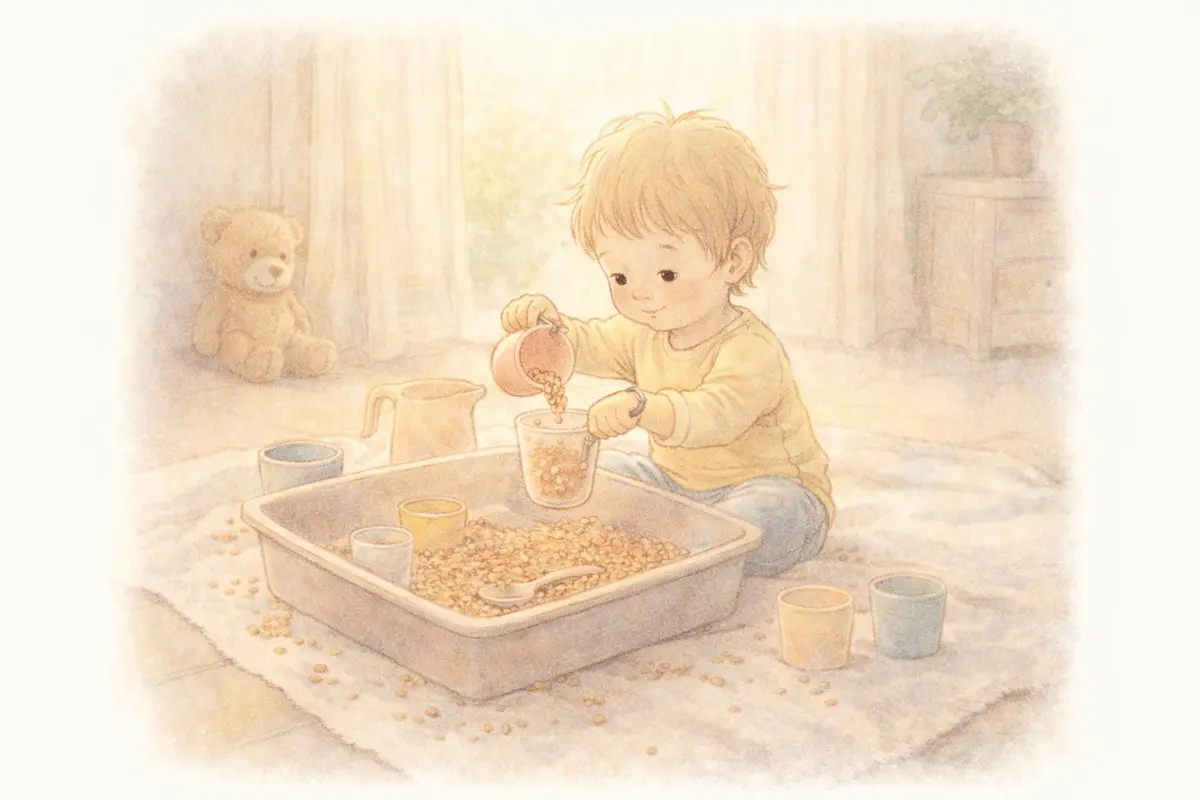
A collection of containers of different sizes — cups, jugs, bottles, bowls — and either water or dry materials like rice, lentils, or sand. The activity is pouring from one to another, scooping, filling, and tipping. This is a staple of early childhood settings for good reason: it builds hand strength, wrist control, and the kind of careful, deliberate movement that fine motor skills require.
In the bath it needs no setup at all — add a few plastic cups and a small jug and your child will occupy themselves for the duration. Outside, a tray of dried lentils with cups and spoons will last longer than almost anything else you offer. Indoors, a deep tray with a towel underneath manages the inevitable spillage.
Threading and lacing
Age 2.5+ · 10–20 mins · No mess
Threading large beads onto a lace, or pushing a lace through holes in a lacing card, is one of the most direct fine motor builders available. It requires bilateral coordination — one hand holds, the other threads — precise pincer grip, and sustained attention. It is also, for many toddlers, deeply satisfying in the way that repetitive, orderly tasks tend to be.
Start large: chunky wooden beads with a stiff lace, or a lacing card with generous holes. Taping the end of a piece of string with masking tape creates a makeshift needle that is easier to handle than a blunt plastic one. As control improves, beads can get smaller and patterns can be introduced.
Tearing and scrunching paper
Age 18m+ · 5–10 mins · Paper mess
Tearing paper — old magazines, newspaper, junk mail — requires both hands working in opposition, building bilateral coordination and hand strength. Scrunching the torn pieces into balls adds a further squeezing and gripping component. Neither activity looks like much from the outside. Both are doing quiet, consistent developmental work.
Turn it into a collage by providing glue and a backing sheet. Or simply let the tearing be the activity — sometimes the process needs no product attached to it. A toddler who tears an entire magazine into small pieces has not made a mess. They have had a fine motor session.
Cutting with child scissors
Age 3+ · 10–15 mins · Supervised
Scissors are one of the most demanding fine motor tools a young child will encounter, and introducing them early — with proper child-safe scissors and supervision — builds the hand strength and bilateral coordination that cutting requires. Start with snipping: single cuts across a strip of paper. The satisfaction of the snip is immediate and compelling, and a toddler will happily snip a strip of paper into confetti for longer than you might expect.
Progress to cutting along a bold, straight line, then gentle curves. The goal at this stage is not precision — it is the repeated opening and closing motion that builds the hand muscles. Let them cut old magazines, junk mail, wrapping paper. Material that doesn't matter removes any pressure from the activity.
Mark-making — before the pencil
Age 18m+ · Open-ended · Colour mess
Before a child can hold a pencil correctly, they need to have made a thousand marks with everything else — chunky crayons, fat paintbrushes, chalk on the pavement, fingers in shaving foam, sticks in mud. Mark-making in its broadest sense is how the hand learns to move with intention across a surface. It is the foundation of all later writing, and it begins long before anyone picks up a pencil.
Offer different tools and surfaces regularly: a tray of sand for finger drawing, a large sheet of paper on the floor with chunky crayons, chalk outside, paint with sponges or cotton buds. The variety matters — each tool requires slightly different grip and pressure, and that variation builds a more complete set of hand skills than any single medium alone.
A note on expectations
Fine motor development follows a broad timeline, but children vary enormously within it. A child who is not yet threading beads at two and a half is not behind — they may simply need more time with earlier-stage activities, or more exposure, or just a few more months. If you have genuine concerns about your child's hand development — if they are consistently avoiding fine motor tasks, showing significant frustration, or not progressing over time — a conversation with your health visitor or an occupational therapist is always worth having. Most of the time what you will hear is: keep playing. Keep offering. Keep making the mess.
That is, in the end, the whole answer. The activities above are not a curriculum. They are an invitation — to play with your child, to watch their hands at work, to notice the concentration and the effort and the quiet pride when something that was hard becomes easy. That progression, small and steady and sometimes invisible, is one of the most remarkable things about early childhood.
You get a front-row seat to all of it. Even the lentil mess.