 Authority · Eating · Early Childhood
Authority · Eating · Early Childhood
Why your child eats better at daycare than at home — and what you can do about it
Introducing the Peer Eating Habit: the phenomenon every daycare professional knows about and almost nobody talks about
March 15, 2026 · 7 min read
It is one of the most common things I hear from parents, delivered with a mixture of relief and mild indignation: "Apparently she eats everything at daycare. Everything. At home she won't touch half of it."
The broccoli that has been refused approximately forty-seven times at the dinner table? Eaten. The lentils that caused a diplomatic incident last Tuesday? Gone without comment. The fish that apparently smells funny and is the wrong colour and sits in a suspicious manner on the plate? Finished, with a spoon, by a child who at home claims to survive exclusively on toast.
If this sounds familiar, I want you to know two things. First: you are not imagining it. Second: it is not about the food.
What is actually happening
After years of working in and managing early childhood settings, I have watched this pattern play out hundreds of times. I have a name for it: the Peer Eating Habit. It is the phenomenon by which children eat more willingly, more adventurously, and more independently in a group setting than they do at home — and it is not magic, or luck, or proof that the daycare cook is doing something your kitchen isn't. It is the result of a specific set of conditions that work together to make eating feel safe, social, and entirely unremarkable.
Understanding those conditions is the first step to recreating some of them at home — not perfectly, because daycare is daycare and home is home, but enough to shift the dynamic at your dinner table in ways that are genuinely useful.
The conditions that create the Peer Eating Habit
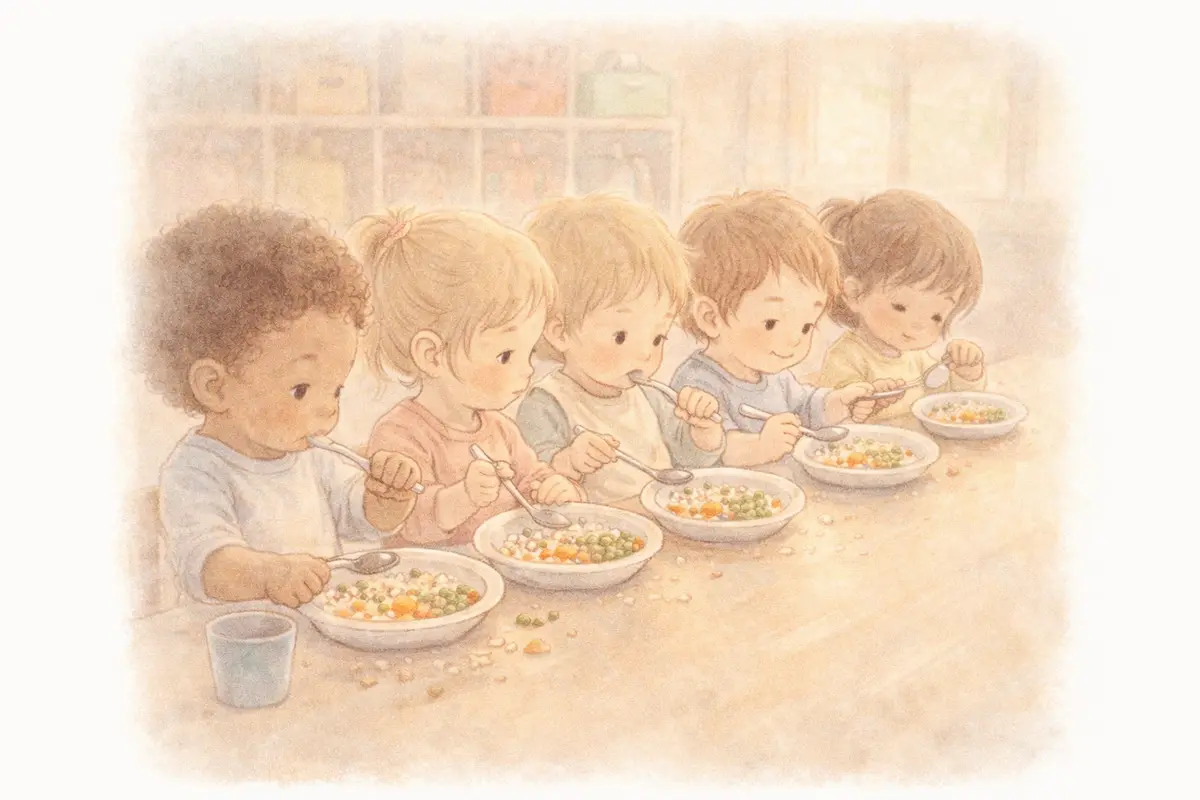
The environment — everything is sized for them. Tables and chairs at child height, plates and glasses and spoons that fit small hands — the physical environment of a daycare dining space is built entirely around the child's body. There is no adult furniture to climb, no glass to worry about dropping, no cutlery that feels unwieldy. The child is physically at ease in a way they rarely are at an adult dining table.
The food — it is made for their palate. Good daycare kitchens cook age-appropriately — flavours that are familiar without being bland, textures that are manageable, portions that are realistic. The food is not a smaller version of adult food. It is food designed for the stage of eating development the child is actually at.
The social dynamic — everyone is doing the same thing. A toddler sitting next to five other toddlers who are all eating the same food, with the same spoon, from the same style of plate, receives a powerful social signal: this is what we do here. Peer modelling at this age is one of the strongest behavioural influences available. A child who would refuse a food at home will often eat it without hesitation when they see peers doing the same.
The ritual — eating is an event with structure. Washing hands, putting on a small apron, sitting in a designated place — these micro-rituals signal to the child's brain that eating time is beginning. The routine is consistent and predictable, which reduces anxiety and increases readiness. By the time the food arrives, the child is already oriented toward the activity of eating.
The language — food is talked about positively. In a well-run early childhood setting, there is no pressure, no negotiation, no "just three more bites." Food is named, described, and spoken about with interest and warmth. "This is butternut squash — can you see the orange colour?" Children who grow up hearing food talked about with curiosity rather than anxiety develop a fundamentally different relationship with eating.
The plating — compartmentalised and considered. Divided plates that keep foods separate, child-sized portions that don't overwhelm, presentation that is simple and unfussy — these details matter more than they appear to. A child who is anxious about foods touching, or who shuts down when faced with a large portion, is given the conditions to approach food calmly rather than defensively.
The independence factor
There is one more element that deserves its own space: independence. In a daycare dining setting, the child is supervised but not managed. A caregiver ensures safety and hygiene and keeps an eye on quantity — but they are not hovering over a single child, anxiously monitoring every bite. The child eats at their own pace, in their own way, with the quiet dignity of someone who has not been asked seventeen times whether they are going to finish their peas.
This matters enormously. Mealtimes at home can accumulate a weight of parental hope and anxiety that children feel acutely, even when nothing is said out loud. The watching, the willing, the silent calculation of whether enough vegetables have been consumed — children read all of it. And for some children, that weight makes eating harder, not easier.
What you can bring home
You cannot replicate a daycare dining room in your kitchen, and you should not try to. But there are elements of the Peer Eating Habit that translate surprisingly well to a home setting, and they do not require much beyond a shift in approach.
Invest in child-sized equipment. A small plate, a short-handled spoon, a cup with a manageable grip. The physical experience of eating changes when the tools fit.
Create a pre-meal ritual. Washing hands together, setting the table, putting on an apron — even one small, consistent signal that eating is beginning primes the child for the activity.
Use a divided plate. Keeping foods separate reduces anxiety for children who are sensitive to mixing, and gives a sense of order to the plate that many toddlers find genuinely settling.
Eat together as often as you can. The peer modelling that works so powerfully at daycare works at home too — children who eat alongside adults and older siblings eat more adventurously than children who eat alone or are served separately.
Talk about food, not about eating. Name colours, textures, smells. "This is a bit crunchy, isn't it?" is a different conversation than "Please eat your carrots." One is curious. The other is pressure.
Reduce the audience. If mealtimes have become tense, try stepping back from the monitoring. Serve the food, sit down, eat your own meal, and have a conversation about something else entirely. The shift in atmosphere is often immediate.
Serve small, offer more. A realistic portion that gets finished feels like success. An overwhelming plate that gets refused confirms the wrong story for everyone at the table.
A word about patience
None of this is a quick fix, and I want to be honest about that. Children who have developed anxiety or rigidity around food at home have usually done so over time, through a combination of temperament and accumulated mealtime experience. Shifting that takes time too — weeks of lower-pressure meals before the new normal begins to settle.
What I can tell you, from having watched the Peer Eating Habit play out in settings over many years, is that children's relationships with food are far more flexible than we tend to believe. A child who currently survives on five foods can become a child who eats twenty. A mealtime that currently ends in tears can become unremarkable. The conditions that make eating easy can be built, gradually and imperfectly, in the most ordinary kitchens.
Your child eats well at daycare not because you are doing it wrong at home. They eat well at daycare because daycare has, quite unintentionally, built the perfect conditions for a small person to feel calm, social, and capable around food.
Now you know what those conditions are. And you can start, one small thing at a time, to build a few of them yourself.