 Parental Guidance · Toddlers
Parental Guidance · Toddlers
Positive discipline for toddlers — or, how to stay calm when a small person loses their mind over the wrong colour cup
Practical tools that actually work, from someone who has used them professionally and then forgotten them entirely at 6pm on a Thursday
March 15, 2026 · 5 min read
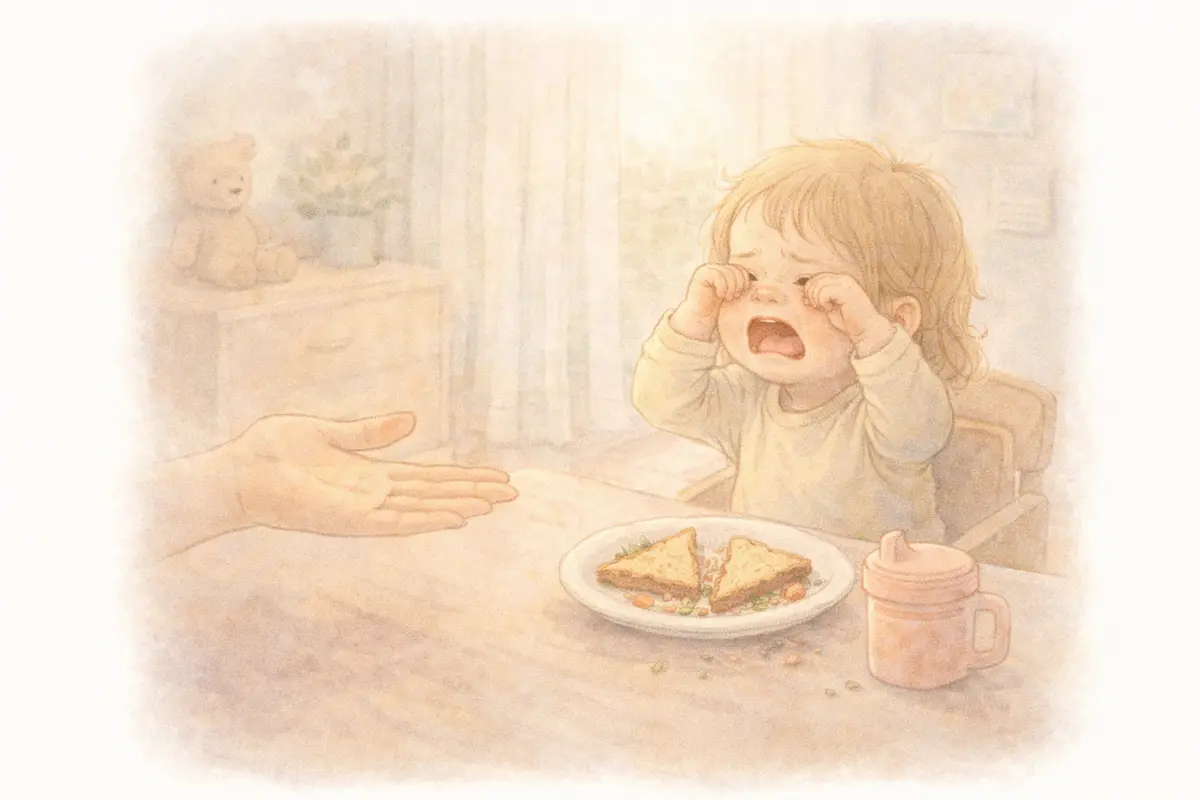
My child once had a meltdown because I cut her toast into triangles. She had asked for triangles. I made triangles. And yet — triangles were, apparently, the greatest betrayal she had ever experienced.
If you have a toddler, you did not need me to explain that. You are nodding. You may be nodding with the hollow eyes of someone who has been nodding for eighteen months straight.
The good news: toddler behaviour makes complete sense once you understand what is actually happening in that tiny, furious brain. The better news: there are approaches that work — not every time, because nothing works every time with toddlers, but often enough to make the days feel more manageable and less like a hostage negotiation you didn't train for.
First, why toddlers behave the way they do
Toddlers are not miniature adults having a bad day. They are people whose prefrontal cortex — the part of the brain responsible for logic, impulse control, and emotional regulation — is about two decades away from being fully developed. When your two-year-old throws themselves on the floor because you handed them the blue cup instead of the red one, they are not being manipulative. They are being neurologically accurate. They genuinely cannot manage that feeling yet. That is your job, for now.
Positive discipline is not about being endlessly permissive, or pretending the behaviour is fine, or never raising your voice (aspirational but human). It is about responding in ways that teach rather than just suppress — so that over time, your child builds the internal tools to manage themselves. That is the goal. It takes years. Be patient with both of you.
Name the feeling before addressing the behaviour
Before you correct anything, acknowledge what your child is experiencing. "You're really frustrated right now. You wanted the red cup and I gave you blue." This is not weakness — it is neuroscience. A child whose feeling is named calms down faster than a child who is simply told to stop. You are not validating the tantrum; you are helping their nervous system regulate so they can actually hear what comes next.
Give limited, real choices
Toddlers lose their minds partly because they have almost no control over their lives. Everything is decided for them — what they eat, when they sleep, where they go. Offering genuine choices within boundaries gives them agency without chaos. "You can put your shoes on now or in two minutes — you choose" is wildly more effective than "Put your shoes on." It works an embarrassing amount of the time. Try it and feel smug.
Say what you want, not what you don't
"Stop running" lands differently in a toddler brain than "walking feet inside, please." The toddler brain processes the vivid action word — running — and often does more of it. Redirect to what you actually want them to do. "Gentle hands." "Quiet voices." "Feet on the floor." It feels strange at first. It works consistently once it becomes habit.
Natural consequences over punishments
Where it's safe to do so, let reality be the teacher. If they refuse to wear a coat and it's cold, they'll be cold. If they throw the toy, the toy goes away for a bit — not as punishment delivered in anger, but as a calm, matter-of-fact outcome. "Oh, that went on the floor. Looks like we're done with that for now." Bored voice. No drama. Drama is fuel.
Connection before correction
When behaviour escalates, the instinct is to correct immediately. But a dysregulated child cannot absorb correction — their brain is in survival mode. Get down to their level. Make eye contact if they'll allow it. A hand on the back. Thirty seconds of pure presence before you say anything about the behaviour. It feels counterintuitive. It is the fastest route through.
A word about consistency
Every approach here requires repetition before it becomes effective. Your toddler's brain learns through repeated experience — which means you will use these tools many, many times before they become second nature for either of you. That is not you doing it wrong. That is how toddler brains are built.
You will also have days where you forget all of it and just survive from one snack to the next. Those days count too. Tomorrow is another go.
And for what it's worth — the fact that you are reading about positive discipline, thinking about how to respond rather than just react, means your child has exactly the parent they need. Even on the triangle toast days.